

PART 3: Why Quick Fixes Fail (Even When They “Work”)


You try something new.
A stretch.
An exercise.
A routine you saw online.
And at first…
It works!
Your pain decreases.
You feel better.
You think:
“Finally! This is the one.”
But then, a few days or weeks later…The pain comes back.
And now you’re left wondering:
“Why didn’t it stick?”
“Did I do something wrong?”
“Why does this keep happening?”
The Real Problem Isn’t That It Didn’t Work
It’s that it worked just enough to be misleading.
Quick fixes often provide:
Temporary relief
Short-term improvement
A sense of control
But they rarely create:
Lasting adaptation
Increased capacity
Long-term resilience
Relief Is Not the Same as Resolution
This is one of the biggest misunderstandings in the rehab world.
Feeling better is not the same as being better.
You can:
Reduce symptoms
Improve mobility
Decrease discomfort
…without ever really changing the underlying capacity of your body.
Why Does Relief Happen So Quickly?
Because your body is incredibly responsive in the short term just about any input.
When you:
Stretch
Move differently
Apply a modality
You can temporarily:
Change nervous system sensitivity
Increase blood flow
Alter perception of pain
This aligns with modern frameworks like the Biopsychosocial Model (we've written a lot on this topic in previous Blog posts). Pain is influenced by more than just tissue. So yes—something can “work.” But that doesn’t mean it solved the problem.
The Missing Piece: Capacity
Most quick fixes focus on:
Reducing symptoms
But they ignore:
Building capacity
Capacity is your body’s ability to:
Tolerate load
Handle stress
Perform without breaking down
Without increasing capacity…You’re just managing symptoms.
Clinical Example: Low Back Pain
A patient with recurring low back pain finds relief with getting "adjusted" and taking time to rest.
They feel better.
They move easier.
But then they:
Lift something
Sit for long periods
Return to activity
…and the pain comes back.
Why?
Because the manipulation (i.e., adjustment) didn’t improve:
Load tolerance
Strength
Movement control under stress
It changed how things felt. It modulated their nervous system for a brief period of time. Not necessarily what the body could handle.
Clinical Example: Tendon Pain
Someone with Achilles or patellar tendon pain tries:
Rest
Soft tissue work
Light exercises
Pain decreases. But when they return to running or jumping…The symptoms return.
Because tendon adaptation requires:
Progressive loading
Time under tension
Gradual exposure
Short-term relief didn’t equal readiness.
The Cycle of Quick Fixes
This is where people get stuck.
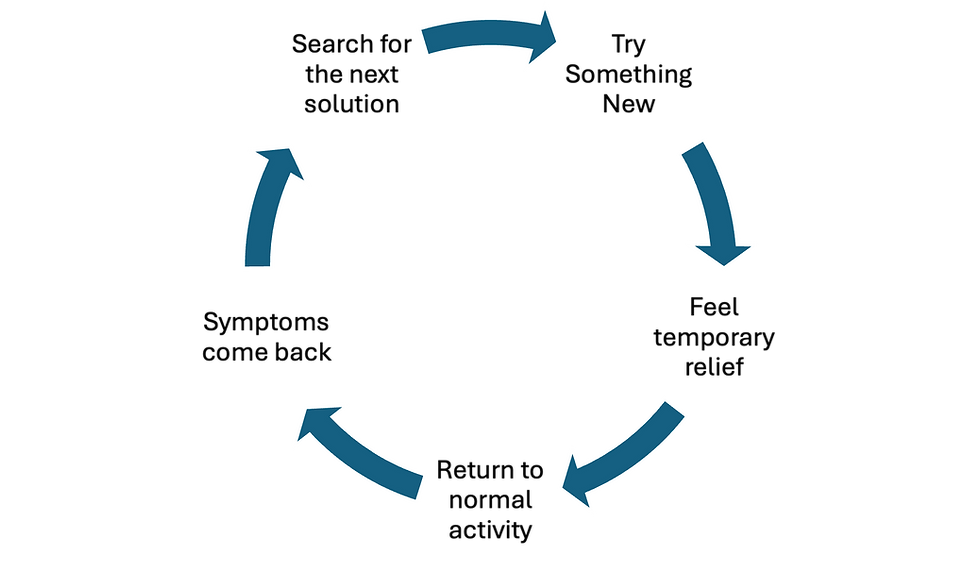
Over time, this leads to:
Frustration
Confusion
Loss of confidence
And eventually:
“I’ve tried everything.”
The Hidden Cost: Dependency
Quick fixes don’t just fail. They create reliance on the next thing.
Instead of building:
Ownership
Understanding
Progression
They reinforce:
External solutions
Passive thinking
Constant searching
What Actually Needs to Change
If you want lasting results, the focus must shift from:
“What makes this feel better right now?”
to
“What makes this stronger, more capable, and more resilient over time?”
Clinical Reality: Adaptation Takes Time
Real change requires:
Progressive overload
Consistent exposure
Recovery and adaptation
Not days.
Not quick hacks.
But enough time for the body to actually become different.
A Better Way Forward
Instead of chasing relief, start asking:
Does this build capacity?
Can this progress over time?
Does this prepare me for real-life demands?
Because the goal isn’t just to feel better.
It’s to become harder to break.
Final Thought
Quick fixes don’t fail because they do nothing. They fail because they don’t do enough. They give you just enough relief to believe you’re on the right path…Without ever getting you where you want to go.
If you’ve been stuck in this cycle, it’s not because nothing works.
It’s because:
You’ve been solving the wrong problem.


Comments